
What Does a Healthy Sourdough Starter Look and Smell Like?
For my first three months of sourdough, I could not tell whether my starter was healthy or not. It looked alive-ish. It smelled like something. I had no idea if that was right.
That was the whole problem, and I did not know it. A weak starter makes weak bread, and if you cannot read your starter you are baking blind. So before anything else, here is how to actually tell what yours is doing.
What a healthy starter looks like
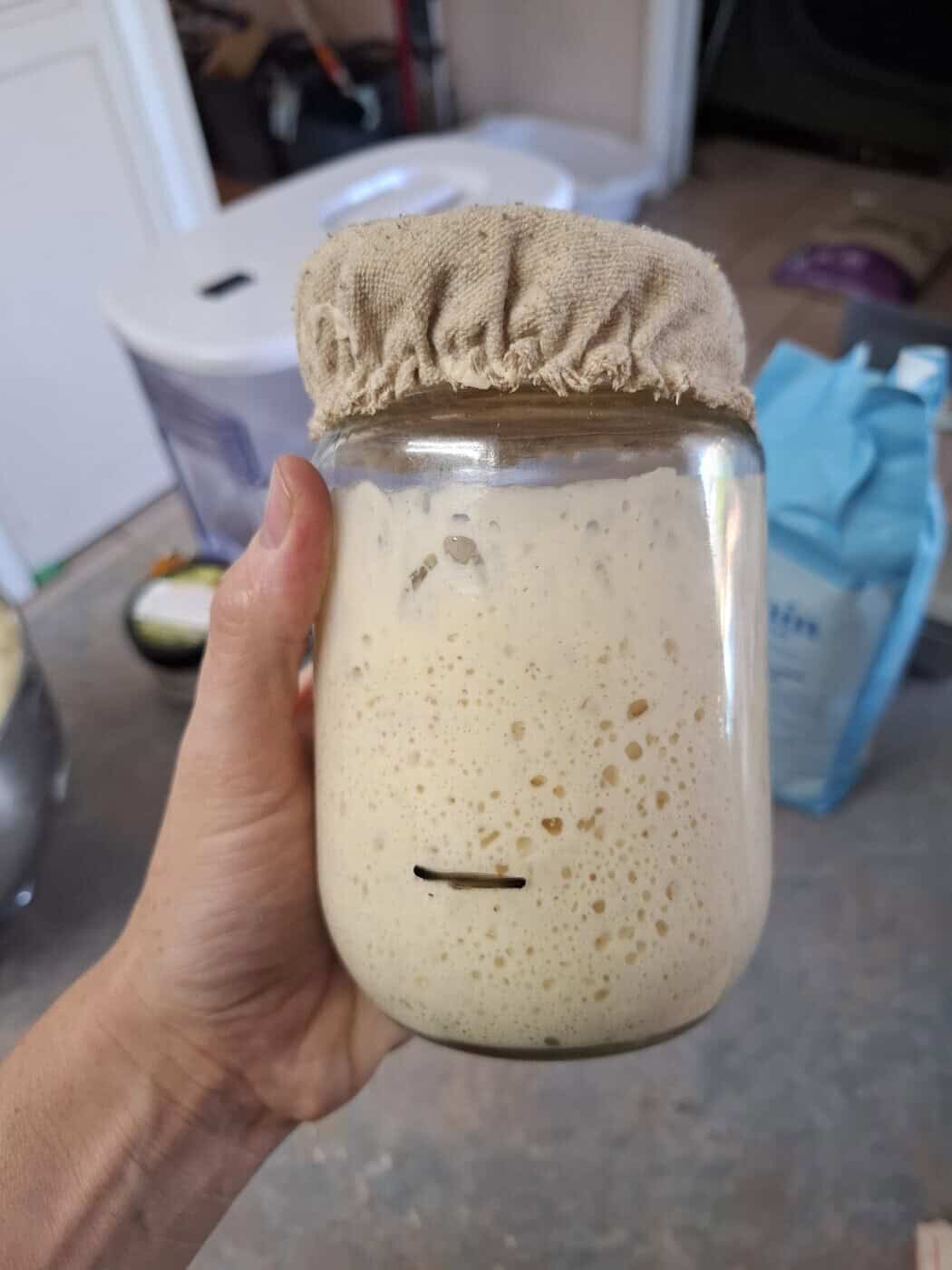
A healthy, active starter roughly doubles in size within four to eight hours of being fed, at room temperature. In an Australian summer it can hit that in about four hours, sometimes less, so keep an eye on it.
You are looking for three things.
It rises and domes. The top puffs up and rounds over rather than staying flat.
It is full of bubbles. You will see them across the surface and, more tellingly, through the side of the jar. That is the carbon dioxide, which is the whole point.
It is stretchy. Pull a bit off with a spoon and it should be elastic and webby, not thin and watery.
The easiest way to see all this is to put a rubber band around the jar at the level of the starter right after you feed it. Come back in a few hours and you can see exactly how far it has climbed.
What a healthy starter smells like
This is the sense people trust least and should trust most.
A good starter smells pleasantly sour and yeasty. Most people land on beer, or plain yoghurt, or a tangy sourness that is sharp but not unpleasant. It should smell alive and a little bit food-like.
It will shift depending on how recently you fed it. Just after feeding it is mild. As it works through its food it gets tangier. That is all normal.
Want more practical Goldfields notes like this?
Join Notes From the Kitchen Table, my monthly email from Kalgoorlie-Boulder. 👉Join here
The warning signs, and what they actually mean
Most things that look alarming are not. Here is how to read them.
A sharp smell, almost like nail polish remover or acetone, means your starter is hungry, not dying. It has eaten through its food and wants feeding, probably more often than you have been. Feed it and it recovers.
A layer of liquid on top, grey or dark, is called hooch. Same message: hungry. Stir it back in and feed. It is not a problem and it is not mould.
Now the ones that genuinely matter.
Any pink, orange or red tinge or streak means something has gone wrong. Discard the whole thing and start again. Do not try to save it.
Fuzzy mould, the same as you would see on off food, means the same. Bin it and start over.
That is the honest list. Two things that look scary but are fine, two things that are rare but non-negotiable.
Why a from-scratch starter fails so often at the start
Here is the thing nobody told me. A starter you make from scratch is not properly strong for weeks. Mine took months, and every loaf in that time was a disappointment I blamed on myself.
A starter grown from scratch has to build up its population of wild yeast and bacteria from nothing, and until it is established it just will not raise a loaf reliably. That is not you doing it wrong. That is the starter not being ready yet.
There are two ways through it. One is patience: feed it once or twice a day, keep it warm, and wait it out until it doubles predictably. The other is to skip the slow, uncertain part and start from a starter that is already proven.
That is exactly why I sell a dehydrated one. It is the same starter I bake with, dried and dormant, and you rehydrate it over a few days into a strong, established culture instead of gambling on a new one. If you have been fighting a weak from-scratch starter, this is the shortcut.
Keeping it alive once it is strong
Once your starter is established, keeping it going is easy, and how you do it depends on how often you bake.
If you bake most days, keep it on the bench and feed it once or twice a day: keep 20 grams, add 120 grams of flour and 120 grams of water. Use it when it has peaked.
If you bake less often, keep it in the fridge and feed it about once a week. It slows right down in the cold, which is exactly what you want when you are not using it.
The good news is that a starter is remarkably hard to actually kill. Look after it and it lasts indefinitely. People pass them down through families for years.
What to do next
Once you can read your starter, the next hurdle is the one that catches everyone in this country: keeping it alive and predictable through a Kalgoorlie summer, when it wants to peak and collapse twice a day.
Read: How I keep my sourdough starter alive in Kalgoorlie
Keep going
If you want more practical Goldfields notes like this, you might like my monthly email, Notes From the Kitchen Table.
It’s a letter from my kitchen table in Kalgoorlie-Boulder, with regional life, home, and what I am making and learning along the way. Subscribe here: youbeautco.kit.com/signup. You can reply to any email and it comes straight back to me.
You can find me on Instagram at @youbeaut.co. I share glimpses of daily life, behind the scenes of making products, and small notes that do not always make it into the newsletter. Nothing polished, just real life in a dry, dusty town.
I also run a Facebook Group for women who want to talk about regional living, swap ideas, and share what is working in their homes. It is a friendly space to ask questions, share wins, and not feel like the only one living a long way from everything.
I hope You Beaut Co helps you feel more at home where you already are.