
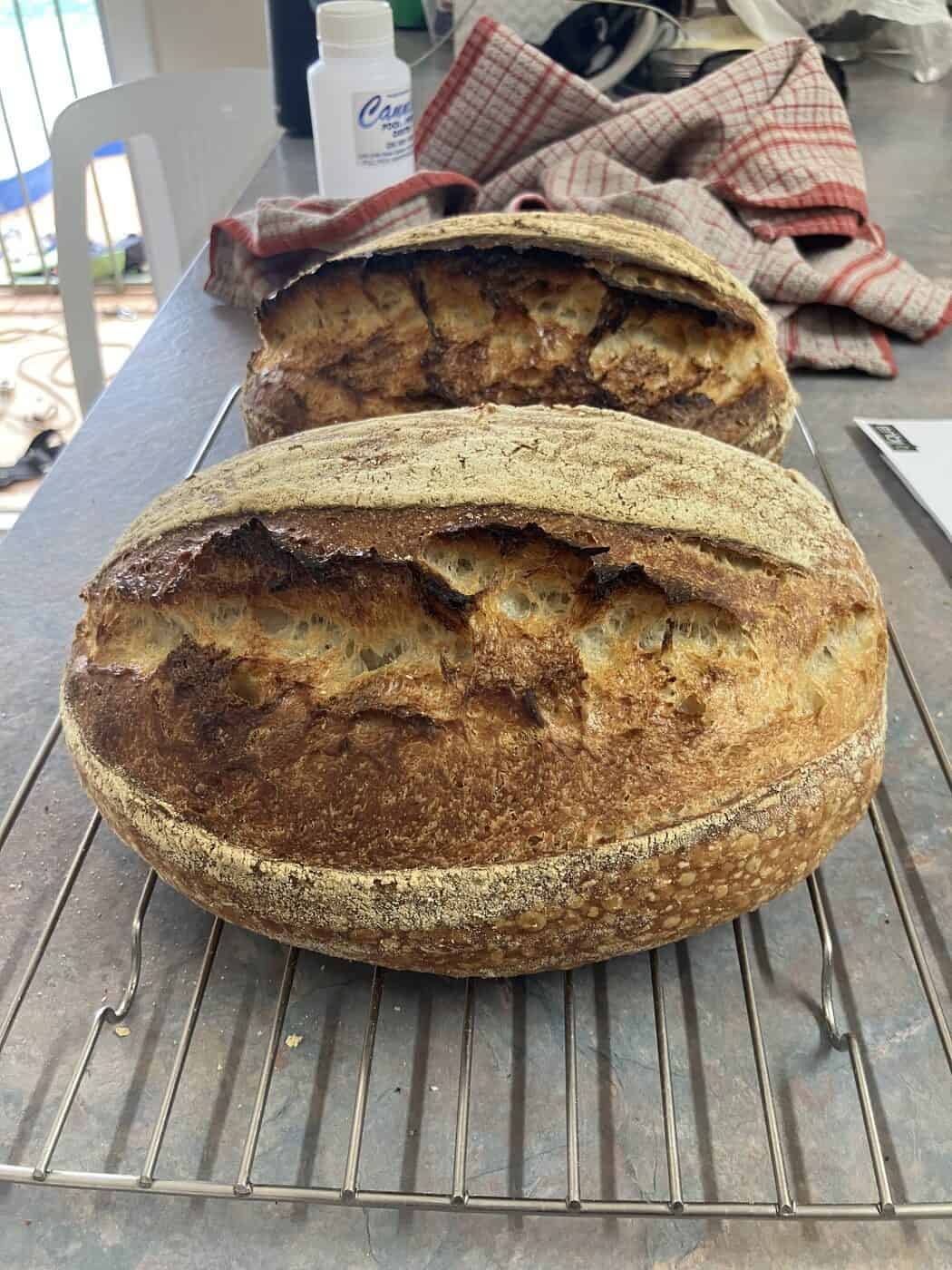
Sourdough for Beginners in a Hot Climate: What Actually Works
Most sourdough guides for beginners assume a mild kitchen. This one does not.
If you are starting out somewhere hot, you do not need more theory about why heat is difficult. You need a method that already has the heat built into it, so you are not trying to translate cool-climate instructions on the fly while your dough races ahead of you. That is what this is.
Here is the whole thing, start to finish, with the hot-weather moves in place from the beginning.
Start with a strong starter
Everything downstream depends on this, so do not skip it. Your starter needs to be reliably doubling within four to eight hours of feeding before you try to bake with it. In summer that might be as fast as four hours.
If yours is not there yet, do not bake with it. A weak starter is the single most common reason a first loaf fails, and no amount of good technique later will rescue it. Get the starter right first.
Use cold water, colder than feels right
This is the easiest and most effective change you can make, and beginners always underdo it.
When you mix your dough, use cold water straight from the fridge, or even iced water in the height of summer. The water temperature is the main lever you have over your dough temperature, and dough temperature is what drives how fast everything moves. Starting cold buys you time.
Want more practical Goldfields notes like this?
Join Notes From the Kitchen Table, my monthly email from Kalgoorlie-Boulder. 👉Join here
Ferment somewhere cool, and make one if you have to
Your dough will bulk ferment far too fast sitting on a summer benchtop. You need to find or make a cooler spot.
Options, in rough order of how much effort they take: the coolest room in the house, often a bathroom or a south-facing room. An esky with an ice brick in it, which makes a surprisingly good temperature-controlled box. Or the oven, turned off, with just the interior light on, which holds a gentle 24 to 26 degrees in many kitchens. Worth checking yours with a thermometer once so you know what your light actually does.
The fridge is also fair game for slowing a bulk that is getting away from you.
Take the temperature of your dough, and write it down
Here is the habit that will teach you more than any recipe. Right after you mix, take the temperature of the dough itself with a probe thermometer, not the air, the dough. Write that number down.
Why bother? Because dough temperature is what decides how fast your dough ferments and how much it should rise before you shape it. Once you know your dough temperature, you can look up what to expect, and you stop guessing. Write down the temperature, the time, and how the loaf turned out, and after a handful of bakes you will have a record of your own kitchen that is worth more than any generic recipe.
The chart I use for this is the one from my own fridge. It matches your dough temperature to a target rise and a rough bulk time, so you have a number to aim for instead of a guess. I put it on a printable card because it is the thing I reach for mid-bake with floury hands. You can get the printable card here.
Watch the dough, and know your target rise
This is the mindset shift, and it is the one that matters most.
A cool-climate recipe might tell you to bulk ferment for five or six hours and let the dough rise by 50 percent or more. In a hot kitchen, both of those are wrong for you. Warm dough ferments faster and, importantly, needs less rise before you shape it. The hotter the dough, the lower the target rise.
This is exactly what the temperature chart is for. It matches your dough temperature to a target rise, so instead of guessing you have a number to aim for. In a hot kitchen your target rise might be as low as 30 percent, sometimes 20, not the 50 to 75 percent a cool-climate guide assumes. If you wait for a big rise in the heat, you have already overproofed.
So start checking at the two hour mark, watch for your target rise rather than a time, and when the dough hits it, domed and jiggly with bubbles around the sides, shape it regardless of the clock.
If it overproofs, bake it anyway
You will overproof a loaf at some point. Everyone does when they are learning the heat.
When it happens, do not bin the dough. Bake it. An overproofed loaf still tastes good, it just will not rise as tall or hold as open a crumb. It makes perfectly good toast, and more importantly it teaches you what “gone too far” looks and feels like, so you catch it earlier next time. A flat loaf is a lesson, not a waste.
Keep it simple for the first few bakes
Do not start with a high-hydration dough, a fancy inclusion, or a complicated shape. Plain white or a simple white and wholemeal mix, a basic round, a Dutch oven. Get the process into your hands first. The interesting variations are far easier once the fundamentals feel automatic, and they will, faster than you expect.
Where to go from here
That is enough to get a real loaf out of a hot kitchen. The rest is practice, and practice out here is mostly about learning to read your own kitchen, since no two are the same.
If you want the whole method in one place, written for these conditions rather than a mild kitchen on the other side of the world, that is what my ebook is. Easy Sourdough for Australian Kitchens walks through the lot, and the temperature card above comes with it as a bonus, so if you buy the book you do not need to buy the card separately.
Keep going
If you want more practical Goldfields notes like this, you might like my monthly email, Notes From the Kitchen Table.
It’s a letter from my kitchen table in Kalgoorlie-Boulder, with regional life, home, and what I am making and learning along the way. Subscribe here: youbeautco.kit.com/signup. You can reply to any email and it comes straight back to me.
You can find me on Instagram at @youbeaut.co. I share glimpses of daily life, behind the scenes of making products, and small notes that do not always make it into the newsletter. Nothing polished, just real life in a dry, dusty town.
I also run a Facebook Group for women who want to talk about regional living, swap ideas, and share what is working in their homes. It is a friendly space to ask questions, share wins, and not feel like the only one living a long way from everything.
I hope You Beaut Co helps you feel more at home where you already are.